Type "best time to post on TikTok" into a search bar and you'll get a stack of authoritative-looking charts that contradict one another. Notice that contradiction, because it tells you something. No single clock setting works across every account, and the reason is structural: the For You feed decides where your videos go based on how people watch them across hours and days, not on the exact moment you tapped publish.
Even so, when you post does carry weight at the edges, particularly in the first stretch after a video goes live. Below, you'll find the broad windows that usually work on TikTok in 2026, followed by a method for working out the slots that suit your own audience, the one schedule that genuinely counts for you.
Why timing carries less weight than the charts suggest
The feed here doesn't run in chronological order. On some platforms a post lands mainly in front of whoever happens to be scrolling at that moment, but TikTok keeps floating your video to fresh viewers for hours, and occasionally days, after it goes up. A clip might sit flat for a day, then start climbing once early watch signals look good. Because that testing period runs so long, the exact minute you chose to publish loses much of its supposed power.
Where timing does bite is that opening surge. Publish while a real chunk of your followers are awake and scrolling, and you can bank quicker views, stronger watch time, and livelier engagement, the very signals TikTok reads when it decides whether to widen a video's reach. Treat timing as a gentle push rather than a switch. It can move a strong video into testing sooner, but it won't rescue one that viewers flick past.
The broad windows that usually pull engagement
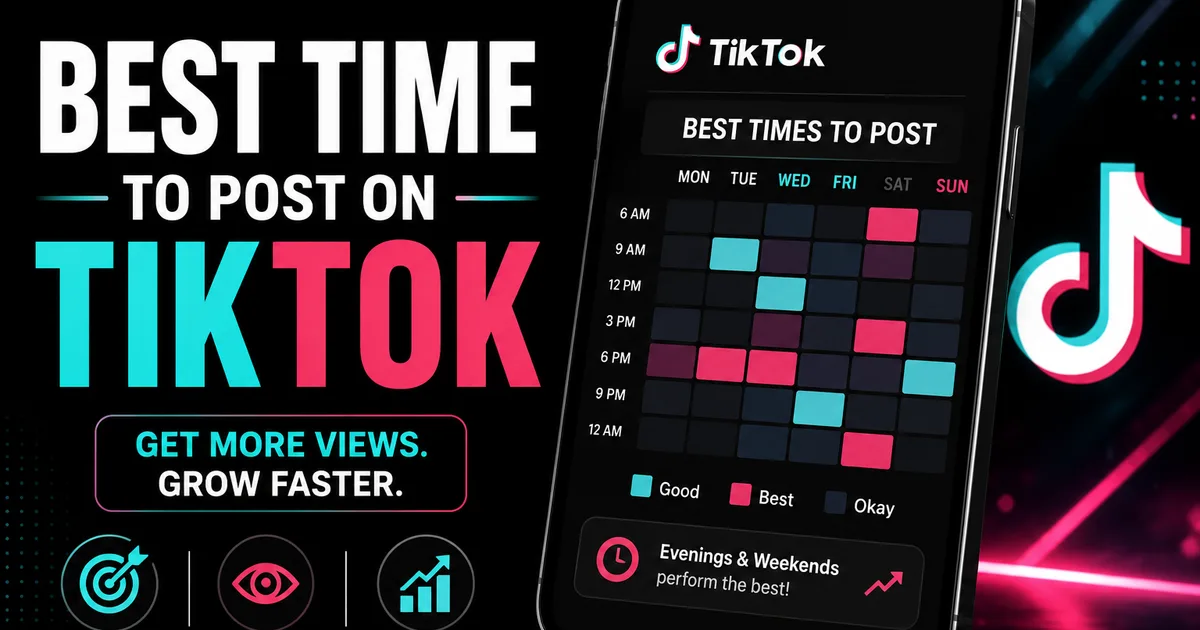
Look across a lot of accounts and engagement clumps around the moments when people pause: the back half of the morning, the lunch break, the early-evening commute or unwind, and the late hours of the night. None of that is a rule, only a pattern, and one that moves with your audience and their time zone. Read the list that follows as somewhere to begin your own testing, not a promise.
The catch is that every one of these hinges on where your viewers actually live. When the bulk of your audience sits in another time zone, schedule against their clock instead of your own. Picture a creator based in California whose following is mostly European: the hours that matter are European evenings, not Pacific ones.
- Weekday mornings, somewhere around 9–11 a.m. in your audience's own zone
- The lunchtime lull in the middle of the day
- Early evening, around 6–9 p.m., as scrolling picks back up
- The later night stretch, which skews toward entertainment and younger viewers
- Weekends, which tend to run longer and spread across more of the day
How to find the time that's genuinely yours
Those generic charts are just a placeholder until you've built up numbers of your own, and building them costs nothing. Inside TikTok's settings, move your account over to Business or Creator, then open analytics. The Followers tab breaks down which days and hours your followers tend to be online, and that, more than any global average, is the timing signal worth trusting, because it reflects the people who actually watch you.
With that in hand, set up a small test. Choose two or three likely windows from the follower-activity view, drop similar videos into each across a couple of weeks, and see which slots bring in early views sooner and hold viewers longer. Keep the winners; let the others go. Since both your audience and your content keep shifting, it pays to run this exercise again every few months.
- Flip your profile to Business or Creator to turn analytics on
- Open the Followers tab to see the busiest days and hours
- Trial 2–3 windows using comparable videos across a couple of weeks
- Weigh early views against watch-through, then hold onto the winners
- Revisit the schedule each season as your following changes
What always outranks timing: the video
If a single element gets your attention, make it the first two seconds. TikTok makes up its mind fast about whether to keep circulating a clip, and a limp opening bleeds viewers off before the algorithm can read anything strong. A tight hook, a clear payoff, and solid watch-through will beat a flawlessly scheduled post that fails to hold people.
Consistency comes in a close second. A steady posting rhythm hands TikTok more opportunities to figure out what you make and who it's for, while keeping you visible to the followers already on your side. A dependable cadence at a reasonable hour will outdo scattered posts dropped at some theoretically perfect one.
How a views boost can play a part
A fair number of creators attach a views boost to a brand-new post, so a little social proof is already sitting on the tally as the clip starts to circulate. When the view number reads higher, the strangers who stumble onto it feel a bit more inclined to give it a watch, which is exactly why timing counts too: both come down to that first impression.
Stay honest about what it can't do. Added views won't steer the For You algorithm, can't manufacture watch time, and won't promise that a clip takes off. Social WOW supplies TikTok views from real sources, working only from your public video link, asking for no password, and backed by a refill guarantee. Lean on it alongside a strong hook and a steady posting habit, never in place of them.