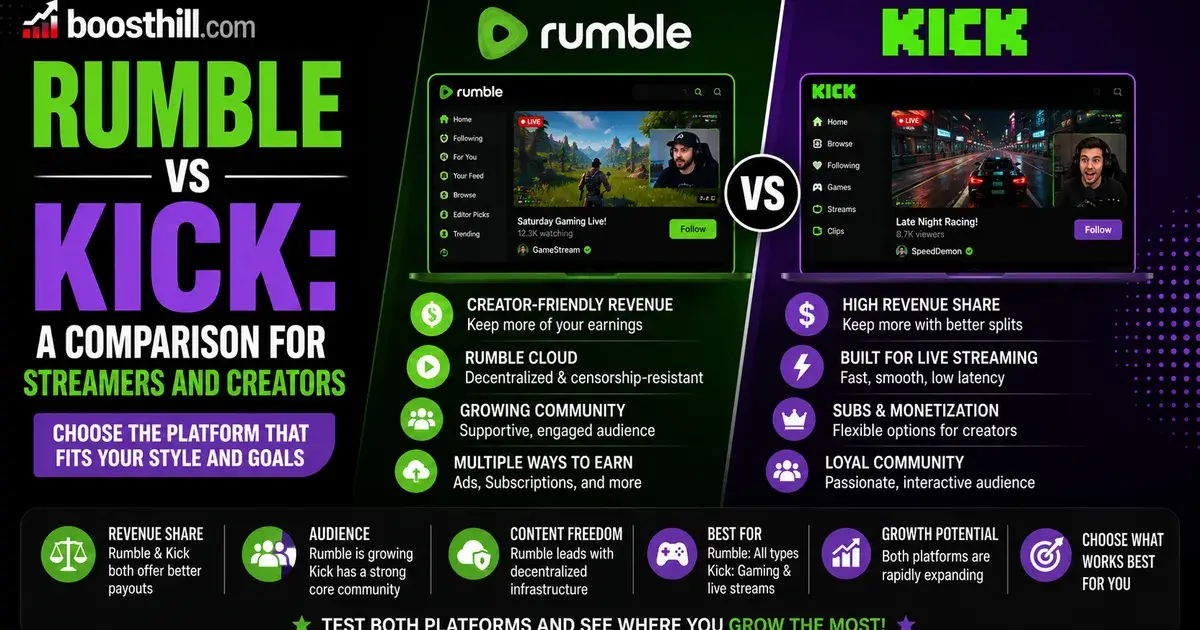
The two names tend to come up together because each positions itself as the creator-friendly option next to the older, bigger services. Underneath that shared pitch, though, they are organized around different priorities. Kick is at heart a live-streaming service aiming squarely at the Twitch crowd, whereas Rumble is a video platform — one with streaming bolted on — that tilts toward news, commentary, and material you upload.
If you are trying to decide between them, the comparison that matters hinges on your routine: whether you go live or post uploads, what each one pays, the crowd you would be building in front of, and the tooling on offer. What follows is a plain accounting of both.
What each platform is built to do
Kick leads with live. Its interface, its chat, and the habits of its community all orbit real-time broadcasts, much as Twitch does, and gaming plus IRL streaming sit near the center of its identity. When going live is the core of what you make, Kick is shaped around exactly that.
Rumble carries live streaming as well, yet at its foundation it is a video service, one where uploads, news, and commentary do much of the heavy lifting. If your output is mostly recorded pieces with the occasional live session, Rumble's wider video remit may suit you; if you live and breathe going live, Kick will likely feel more like home.
- Kick puts live first, with a Twitch-flavored look and community
- Rumble is a video platform where streaming is one piece of the picture
- Gaming and IRL tend toward Kick; commentary and uploads toward Rumble
- Let your usual format settle the question
How the two handle money
Kick made a name partly through a generous split on subscription revenue, paired with tipping, and that arrangement has been central to how it sells itself to streamers. The specifics — and whatever thresholds apply — are subject to change, so check where things stand today before you plan a livelihood around them.
Rumble's side of the ledger includes ad revenue, subscriptions and tips, plus a licensing route for the videos you upload. It favors a different blend of content, and what you make hinges on views, how much advertisers want your audience, and your subject. As on any platform, treat published payout numbers as ballpark and assume they will move.
The candid summary: Kick's subscription split has been the eye-catching part of its offer to live streamers, while Rumble leans on a wider spread of ways to earn across both live and recorded video. Neither one promises you an income.
Who is watching, and how they behave
The people on Kick lean toward live entertainment — gaming, just-chatting streams, IRL — and the room feels like other live audiences do, with quick chat and an appetite for interaction as it happens.
Rumble's viewers tilt the other way, toward news, politics, and commentary, and a real portion of them turn up for uploaded videos rather than live sessions. Material that speaks to that world tends to land better with Rumble's crowd; if you are an entertainer who thrives on going live, Kick's culture is probably the closer match.
Features, stability, and the surrounding ecosystem
Both are newer than the giants they challenge, which means their tools and their steadiness are still catching up to the longest-established names. Kick has poured resources into its streaming pipeline and the tools creators use; Rumble spreads its effort across a fuller video ecosystem that takes in hosting, uploads, and distribution.
It helps to think in practical terms: how steady the stream stays, what the mobile side is like, how clips and VODs are handled, and how painlessly you can carry an existing audience across. For a lot of creators the real tiebreaker is simply where their viewers already sit, or whose format lines up with what they make.
- Kick: concentrated investment in tools for going live
- Rumble: a wider video ecosystem spanning uploads, hosting, and distribution
- Both are still catching up to the biggest incumbents
- Where your audience already is tends to matter more than the feature list
So which one is right for you?
If live is your whole game — gaming or IRL above all — Kick's live-first build and its subscription model were made with you in mind. If you revolve around uploads, news, or commentary, or you simply want one place that does live and on-demand equally well, Rumble is the more natural fit. A lot of creators try both for a while before they commit to either.
Whatever you land on, a visible follower or subscriber count helps newcomers take the channel seriously in those first few seconds. If Rumble is where you want a running start, Social WOW can hand your channel followers from genuine, active accounts and asks for nothing but your public link — a modest credibility boost that works best next to a consistent streaming and posting habit, not as a substitute for it.