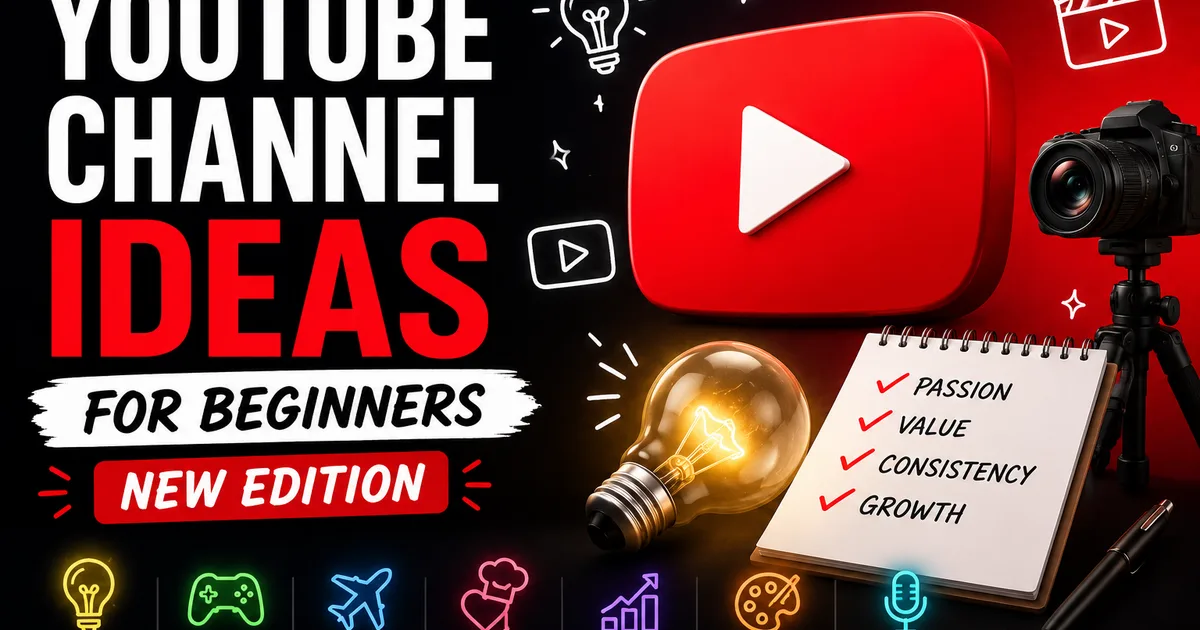
When people picture the difficulty of launching a channel, they usually think about gear or editing software. In practice, the real sticking point is figuring out what your videos will actually be about. Choose a subject you cannot keep up with, and the uploads tend to dry up after the first few. Choose one that matches your curiosity and your daily life, and you end up with a well you can draw from for years, which happens to be what the platform tends to reward.
Consider this a jumping-off point if you are new and want ideas that are genuinely doable in 2026, paired with a straightforward method for settling on a niche you can commit to. We will walk through categories that reliably work, cover formats that ask little of your gear, and close with how to make a fresh channel look credible so those first uploads get a fair hearing.
Choose a lane you can keep up with
Rather than jumping straight at one clever idea, start with the groundwork. The strongest niche lands where three things meet: what you care about, what you already understand, and what people are genuinely looking for. Pour yourself into a subject nobody searches, and progress will crawl. Commit to something in demand that leaves you cold, and you will run out of steam. What you want is a topic you would still be glad to discuss on a day when filming feels like a chore.
Be realistic about what you can turn out on repeat. Running a channel means producing the same sort of thing over and over, so lean toward a topic and format you can keep renewing week to week without hitting empty. It pays to start narrow enough to be noticed, then widen your scope later, once there are people watching.
- Look for where your interests, know-how, and audience demand intersect
- Settle on a format you can sustain without wearing yourself out
- Begin in a narrow lane and widen it over time
- Confirm there is real search interest behind the topic
Categories that tend to work for newcomers
A handful of categories stay reliably popular because they answer the things people are forever typing into search: how to do a task, which product to pick, or how to feel part of a community around a hobby. They make solid territory for a first channel, since the demand rarely dries up and there is room inside each one to stake out an angle of your own.
Read the list that follows as a set of prompts, not a fixed menu. The real advantage shows up when you shrink a broad category into a corner you can own: "cooking" might become "15-minute meals for one," while "tech" becomes "budget phone reviews."
- Tutorials and walkthroughs in a skill you have genuinely mastered
- Reviews, side-by-side comparisons, and guides for buyers
- A hobby focus such as crafts, gaming, gardening, fitness, or music
- Money management, productivity systems, or study techniques
- Recipes or cooking shaped around a particular diet or limitation
- Commentary, reactions, or plain-language explainers on a subject you track
Formats that need barely any gear
An expensive rig is not a prerequisite. Many channels find their footing with nothing more than a fairly current phone, light from a nearby window, and audio that comes through cleanly. Your choice of format carries much of the load here, particularly the ones built on screen captures, voiceover, or a straightforward shot of you speaking to camera.
Shorts are worth calling out because they drop the barrier lower still. One phone, a passing idea, and a vertical clip give you enough to see what connects before you sink time into longer pieces. A lot of newcomers use Shorts to get their bearings, then grow whichever ideas stick into full-length videos.
- Screen-capture tutorials and step-by-step software demos
- Voiceover pieces laid over slides or stock footage
- Straight-to-camera tips shot on a phone in decent light
- Brief vertical clips for testing ideas in a hurry
- Top-five or list-style videos that are quick to script
Test the idea before you go all in
Before you sink months into a direction, run a fast sanity check. Type your topic into YouTube's search and note what is already there, how fresh the uploads are, and whether your angle has space to breathe. A bit of healthy rivalry usually signals that viewers exist; an empty field can just as easily mean nobody is asking for it.
Next, jot down the first ten videos you could actually see yourself filming. If that list comes together without much effort, the niche has room to run. If you stall somewhere around the third one, it is probably too tight a lane, or simply not a subject you care about enough to keep going.
- Run the search and study which videos already rank
- Hunt for a distinct angle you can make yours
- Sketch out ten possible videos before you settle in
- Go with the niche whose list came together most easily
Help a new channel look the part
A fresh channel runs into a chicken-and-egg bind: people hesitate to subscribe to something that looks like it opened yesterday, even when the videos are genuinely good. Filling out the profile goes a long way, from a clear handle and a tidy banner to a description that says what you are about and a few uploads already live so the page does not feel bare.
Social proof feeds into that same first impression. A small, believable subscriber number can make a young channel read as more established to someone weighing whether to click subscribe. Social WOW delivers subscribers from real, active YouTube accounts, drawing only on the public link to your channel, with no password changing hands and a refill guarantee behind it. On its own it will not produce views, watch time, or monetization, and it is no replacement for posting consistently, but it can hand a new channel a credible footing while you do the work of building.