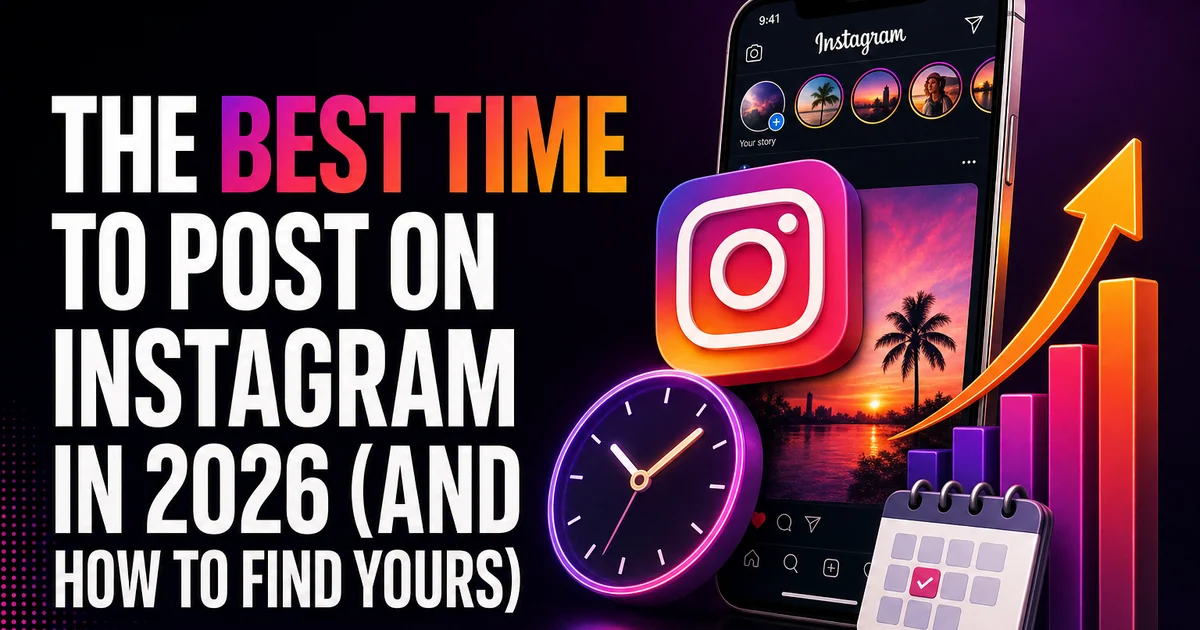
Line up any two 'best time to post' charts and they will contradict each other — which is the real tell. No single hour works for every account. The time that suits you depends on when your particular followers are awake and scrolling, and that pattern lives inside your account alone.
Timing still earns you something at the edges, most of all in the opening hour after a post goes live. Below is a set of broad windows worth trying in 2026, then a method for finding the hours that actually count for your own audience.
Your followers matter more than any chart
When something new goes up, Instagram serves it to a fraction of your following before anyone else. When that first batch lingers, taps like, saves, and shares within minutes, the platform reads a vote of confidence and pushes the post wider — onto Explore, into the Reels feed, and across more home feeds. Publishing while your people are already scrolling tilts that opening hour in your favor.
Even so, a strong post at an awkward hour still beats a forgettable one at the ideal moment. Think of timing as a gentle push, not a switch you throw. The windows below are a place to begin, not a law to obey.
The broad windows most accounts see in 2026
Across a lot of accounts, activity tends to bunch up mid-morning and in the early evening on weekdays — the times people grab a phone before work, at midday, and once the evening winds down. As loose starting points:
- Mornings on weekdays, in the ballpark of 8–11 a.m. wherever your audience lives.
- The midday stretch on weekdays, somewhere between 11 a.m. and 1 p.m.
- Weekday evenings from about 6 to 9 p.m., frequently the best-performing slot.
- The middle of the week, Tuesday through Thursday, tends to beat Mondays and weekends across a lot of niches.
How to pin down your own best time (this is what counts)
If you are still on a personal profile, switch to a business or creator account — it costs nothing. Then head into Insights, open Total followers, and find Most active times, where Instagram lays out the exact days and hours your followers are online. Aim to publish 30 to 60 minutes before those peaks, so the post is fresh as the crowd arrives.
After that, run your own experiment. Choose two or three likely windows, post into them steadily for a few weeks, and compare the reach and early engagement each one earns in Insights. What your own account tells you beats a generic chart every time.
Rhythm and format outweigh the clock
Showing up on a regular schedule teaches your audience what to expect and gives the algorithm a pattern to learn. A dependable rhythm you can actually sustain matters far more than hitting one perfect minute. Reels pull the broadest reach in 2026, so put video first, grab attention within the first two seconds, and earn the saves and shares that mark real value.
One thing underpins all of it: a schedule only does its job when there are real people on the other end. A following made of genuine, engaged accounts is what turns any posting plan into something that pays off.